

The Collegiate Recovery Leadership Academy (CRLA) is an academic-year-long fellowship for students passionate about the intersections of addiction and mental health recovery, leadership, and advocacy.
CRLA Fellows design and implement a prevention, harm reduction, or recovery-focused Impact Project on their campus. Throughout the program, Fellows receive advocacy and leadership training, attend two in-person events, and join a supportive national cohort of student leaders committed to shifting the culture in higher education.

Applicant Criteria
To apply, students must:
- Be enrolled in post-secondary coursework for the full academic year of participation
- Have completed at least one year at their college or university (familiarity with your campus helps when creating change)
- Demonstrate interest in addiction and mental health recovery, leadership, and advocacy.
Benefits of CRLA:
As a CRLA Fellow, you will:
- Design and implement an Impact Project on your campus
- Shape the future of prevention, harm reduction, and recovery in higher education
- Strengthen your leadership skills while furthering professional and personal development
- Receive training grounded in social justice to create sustainable change
- Build relationships with other passionate students and mentors from across the country
- Attend two all-expense-paid trips to connect with CRLA peers and mentors
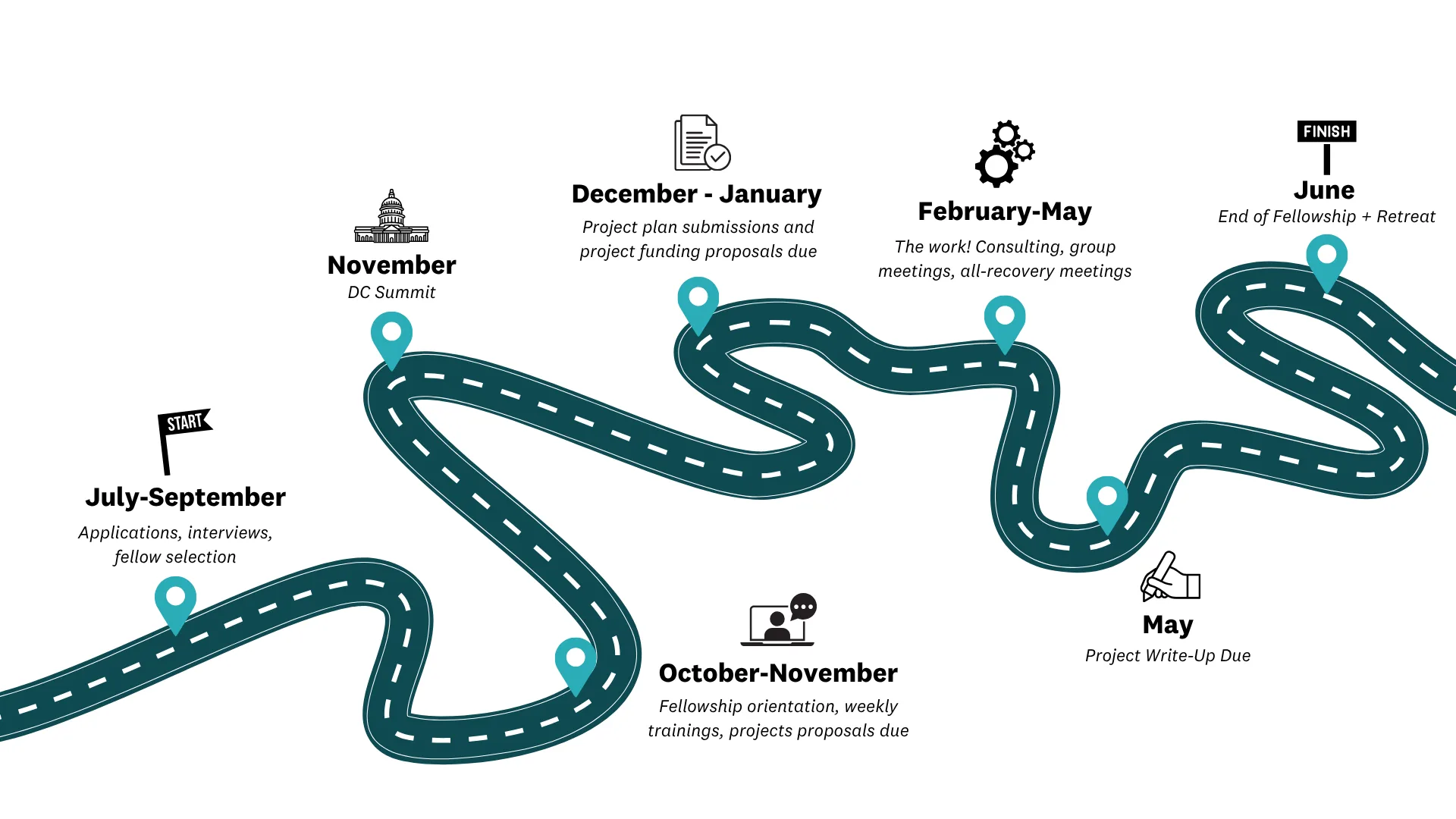
Program Timeline
CRLA’s Impact
CRLA 2025-2026 Impact Book
Throughout the year, CRLA Fellows and Working Group Leaders (WGLs) designed and implemented Impact Projects on their campuses, centering prevention, harm reduction, or recovery. Additionally, they participated in trainings focused on leadership and recovery-supportive practices, attended two in-person events, and connected monthly with a supportive cohort of peers and mentors from around the country. At its core, the CRLA seeks to develop student leaders as they create meaningful and lasting change in the lives of those in their communities.
This booklet reflects the dedication, passion, and hard work of the 2025-2026 cohort of CRLA Fellows and WGLs. Collectively, Fellows and WGLs worked to establish or expand collegiate recovery initiatives, host allyship and educational trainings, distribute harm reduction and overdose prevention supplies, raise awareness and combat stigma, lead artistic recovery support activities, influence campus policy or structural change, conduct research, and secure dedicated space for students in recovery to gather. Projects impacted college students, campus faculty and staff, local communities, and recovery organizations.
Together, Fellows and WGLs worked across 30 campuses, reaching more than 4,250 individuals throughout the United States. Yet these numbers only tell part of the story. Throughout the program, Fellows and WGLs navigated challenges, adapted to changing campus climates, built relationships, and made space for connection and support within their communities. While many projects have tangible outcomes, they don’t always go as planned, which is why success, in our minds, is not defined by metrics alone.
Katie King, CRLA ’25 Graduate

The chance to collaborate with peers and mentors, share experiences, and develop leadership skills while advocating for mental health and addiction recovery is both fulfilling and empowering. Additionally, being part of a movement that seeks to reduce stigma and promote awareness around recovery aligns with a passion for creating inclusive and supportive environments for all students.
Campus
North Carolina State University
Frankie Berryman, CRLA ’24 Graduate
I loved the general structure/idea of the CRLA, where we got to focus on a specific project addressing needs in our communities. Walking through the entire planning and execution process from start to finish was very fulfilling and taught me a lot about planning, research, and execution.
Campus
Kennesaw State University
Fiona Knoster, CRLA ’23 Graduate

CRLA was truly a one-of-a-kind experience. This program gave me the opportunity to use my experience with being impacted by a loved one’s substance use disorder to create positive change on my campus. I’m so grateful for the opportunity CRLA has given me to be a catalyst in starting and encouraging the discussion of recovery and substance use disorder awareness on my campus and in the surrounding areas. Throughout these past eight months with CRLA, I have found purpose in my experience and gained confidence like none other in my capability to make a difference.
Campus
University of Pittsburgh, Johnstown
Melissa Hall, CRLA ’21 Graduate

Before I started my journey with the CRLA I thought that I was alone in my vision to bring addiction recovery awareness to higher education. This program has shown me that is not the case and that I am in fact surrounded by many others who share my values, hopes, and dreams.
Campus
Iowa State University
Matthew Patterson, CRLA ’21 Graduate

The CRLA gave me a voice. I felt empowered and accepted. I learned that there is value to my lived experience and that my past is my greatest resource. I was able to connect with other students in recovery and feel like less of an imposter. I learned I was not alone and that, if I had the courage, I could make a difference on my campus, and I did, all because the CRLA supported me every step of the way.
Campus
Florida Atlantic University
Lilinoe Kauahikaua, CRLA ’20 Graduate
This was an absolutely incredible program. Not only has this helped to grow our campus program, but I myself have grown. I have gained confidence and been able to connect with people I never would have been able to connect with without this program.
Campus
University of Hawai’i, Mānoa
Learn More About CRLA’s Impact
For over 7 years, the Collegiate Recovery Leadership Academy (CRLA) has partnered with students across the country, providing the tools, training, and community needed to advance substance use and mental health prevention, harm reduction, and recovery on their campuses.