

Kids develop the “what if?” machine. They can argue, question, negotiate, poke holes in logic, and test boundaries. If the prevention message does not evolve, it stops landing.
At 10 years old, Dr. Crystal Collier was the kind of kid adults don’t worry about much. She describes herself as “really happy, outgoing, enthusiastic.” Then her parents divorced, her family moved to a big city, and fear quietly took the wheel.

When she arrived to enroll in a new school, she spotted a sign for summer school and had what she thought was a genius idea: join summer school to make friends before the year starts.
It worked. She made friends fast. The problem was, many of the kids were in summer school because of risky choices, and she started making some of the same ones.
That pattern followed her as her family moved again and again. “I was using alcohol by about 12 years old,” Dr. Collier shared. “I had tried other drugs by the time I was 14. By the time I was 16, I was an intravenous user.”
At 18, she went to treatment. She survived. And she has been sober since February 3, 1989.
When she returned to school, one question wouldn’t let go: why would a smart, straight-A kid make decisions that nearly cost her life?
That question became her career. And eventually, it became a prevention approach designed for real life.
Dr. Collier’s work came to SAFE Project’s attention through the Prevention Leaders Network, a vibrant and growing community that connects prevention professionals from around the world to share evidence-informed strategies and real-world solutions. Her neurodevelopmental approach closely aligns with SAFE Project’s commitment to practical, science-based prevention that supports parents, educators, and communities in reducing risk and strengthening protective factors across the lifespan.
The question that changed everything: “Is my kid a bad seed?”
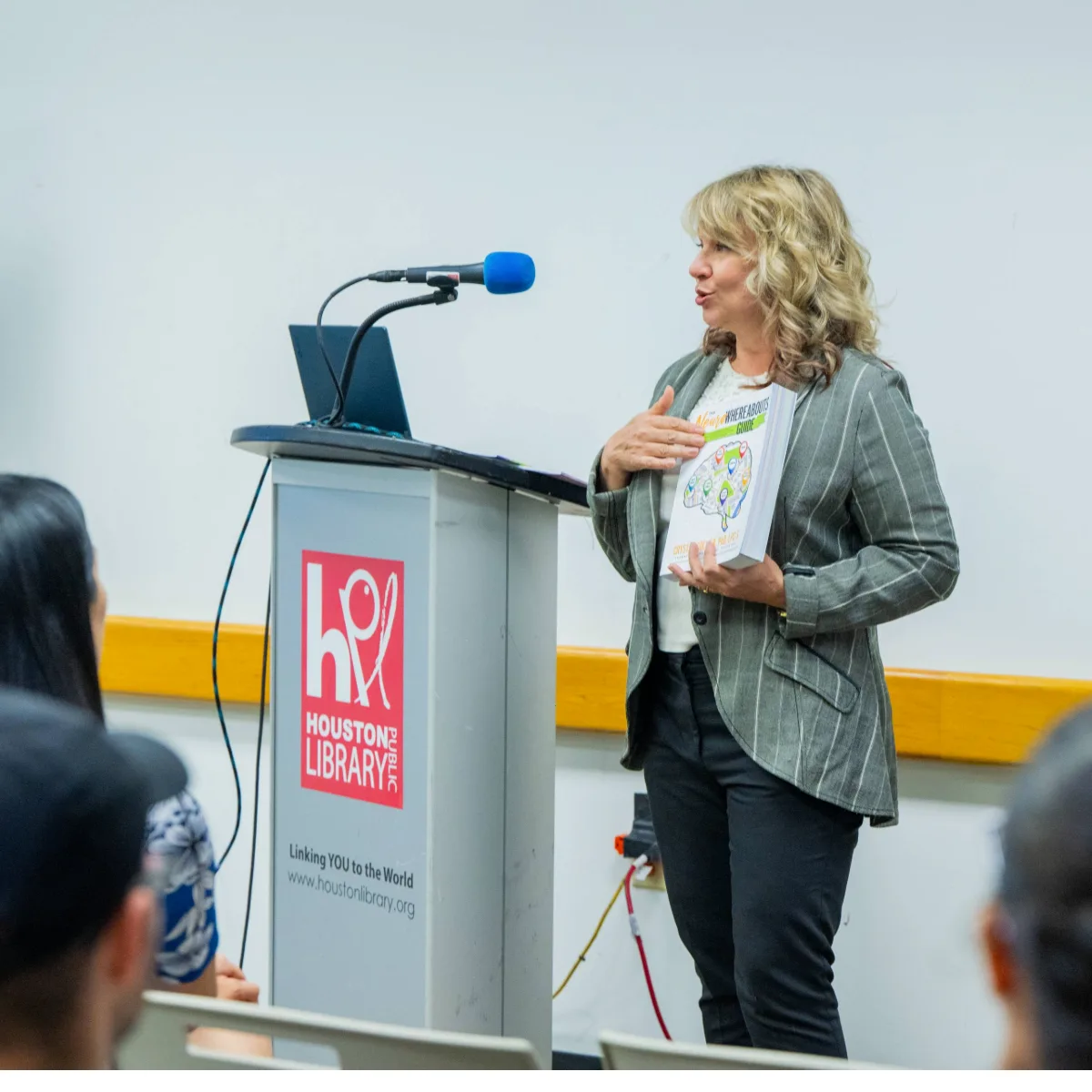
Dr. Collier’s first major project, The NeuroWhereabouts Guide, wasn’t written for academics or clinicians. It was written for parents who are scared, overwhelmed, and trying to do the right thing.
A pivotal moment came when a parent asked her, “Is my kid a bad seed?”
The mom’s middle-schooler had stolen money from her purse, and she was panicking. She hadn’t raised her that way. Dr. Collier’s response was basically: you’re not looking at “bad,” you’re looking at development.
“That’s kind of developmentally normal for that age,” Dr. Collier explained. Kids go through predictable stages where they lie, test limits, and make impulsive choices. Parents often interpret that as moral failure because no one handed them a simple map of what the brain can and cannot do at different stages.
She coined the term ‘neruowhereabouts’.
She wanted parents to know their child’s “neuro-whereabouts,” meaning: what is the brain capable of right now, and what skills are still under construction? Then, the important part: what can I do as a parent to build those skills?
Parents have told Dr. Collier it feels empowering to finally have that information “right at the right time.”
Prevention that works like brain development works
Dr. Collier’s approach is grounded in a simple idea that most prevention efforts ignore: kids’ brains change constantly, and prevention has to keep pace with that.
She pointed to what research shows about “one-and-done” prevention. A big school event (think Red Ribbon Week assemblies and guest speakers) can create a short-term shift, but the impact often fades within 30 to 60 days.
Why? Because the brain keeps growing, life keeps happening, and the message isn’t reinforced.
Dr. Collier frames it this way: a child’s brain changes every 30 to 60 days, so prevention needs to show up consistently across their development, not once a year.
And it is not just about substances. She wants prevention to match the “whole kid” reality.
“I didn’t want to just have an effect on drug and alcohol use,” Dr. Collier said. “I wanted the whole picture, the whole kid and all the things that they are being inundated with by addiction-for-profit industries.”
In her words, that includes not only alcohol, nicotine, and drugs, but also gambling, technology overuse, pornography, and more.
Why “just say no” falls apart in middle school
One of the most useful parts of Dr. Collier’s framework is how clearly she explains developmental shifts, especially the one that hits in late childhood and early adolescence.
Before puberty, many kids are concrete thinkers. They respond to rules and “good vs. bad” framing. A simple “don’t do it” can work better when their brains are still wired to follow structure.
Then middle school hits, and a new cognitive power starts coming online: abstract reasoning.
Kids develop the “what if?” machine. They can argue, question, negotiate, poke holes in logic, and test boundaries. If the prevention message does not evolve, it stops landing.
Dr. Collier’s point is straightforward and practical: the same message won’t work at every age.
Dr. Collier breaks down the brain science in her KnowYourNeuro resources into practical applications through the use of videos, exercise and discussion guides. Inside Your Moves Matter: The Playbook for Teens for Smart Choices and Big Wins, there is real information and brain-based guidance on 18 different topics including alcohol, vaping, cannabis, illicit drugs, screen-time overuse to name a few. All topics selected by teens for teens. The guide explains the science behind why your choices matter – especially while your brain is still developing.
“If you show them the brain studies,” Dr. Collier said, “it’s so much more impactful than just saying no.”
She also shared a powerful example: bullying tends to peak in middle school, right before empathy and other executive functioning skills strengthen. If parents and schools anticipate that window, they can “inoculate” kids with skills before the worst of it happens.
The protective factor that most people underestimate: parents
Dr. Collier repeatedly returns to the same truth: parents matter more than they think they do.
Even in high school, even when it feels like peers are everything, research and real-world feedback keep pointing to parents as a top influence. In her dissertation work, after four years of a prevention program in a Houston-area high school, she interviewed students about what shaped their choices.
While students said the program was memorable and did influence decisions, Dr. Collier emphasized something many parents do not believe: “The number one influence for all kids is parents.”
That matters because so many parents feel doomed from the start. They assume their kid will “do it anyway,” or that they will not be able to say no. Dr. Collier pushes back hard on that mindset.
Her approach is built around giving parents usable tools and language that helps them stay involved without becoming intrusive.
A prevention program built for the real constraints schools face
Dr. Collier’s dissertation program was intensive: it saturated the school environment with consistent, brain-based prevention messaging. Over four years, she and her team focused on 15 high-risk behaviors, and seven decreased in statistically significant ways.
But she also saw the obstacle schools face constantly: even good prevention programs can be expensive and fragile.
She spoke to schools that had spent thousands on curricula and training, only to lose key staff within two to four years due to normal attrition. Programs disappear when the person carrying them leaves.
That problem shaped Dr. Collier’s next move: build something that can outlast staffing changes and budget constraints.
She created Know Your Neuro, a free, online prevention program designed to be “plug and play.”
And importantly, it’s structured to fit into how schools actually operate:
- Teachers do not need to become therapists. Dr. Collier encourages them to learn a short list of executive functioning skills and reinforce them using brain-based praise and teaching.
- Counselors, advisory staff, and Social Emotional Learning (SEL) specialists can use short videos focused on specific topics or skills.
- Administrators can reinforce prevention through simple, consistent touchpoints. Dr. Collier built a calendar with prevention dates, morning announcements, and editable emails that principals can send to families.
She also described how one rural school in Michigan uses the program: they send families links to the same videos students watched that day, so parents can be on the same page at home.
That’s the “village” model in action, without asking exhausted staff to invent everything from scratch.
What “comprehensive prevention” looks like, without the jargon
Dr. Collier explained prevention using frameworks schools recognize: universal, selected, and indicated (often described as Tier 1, 2, and 3).
In plain terms:
- Universal (Tier 1): everyone gets prevention information and skill-building.
- Selected (Tier 2): extra support for kids at higher risk.
- Indicated (Tier 3): support for kids already showing clear signs of risky behavior or consequences.
Dr. Collier’s point: the most effective prevention is comprehensive. Kids who need Tier 3 support still benefit from Tier 1 messages too. You do not isolate “the problem kids” and call it prevention. Dr. Collier shared a practical, statistic-backed truth that a lot of parents need to hear: delaying substance use reduces later risk.
She explained it through brain development. Early substance use disrupts the limbic system and downregulates the frontal lobe, slowing the development of executive functioning skills. Those skills are exactly what helps young people learn from consequences and make better decisions later.
So when parents worry that delaying alcohol will make kids “go wild” in college, Dr. Collier calls that backwards. Most people make some questionable choices in college, but kids who delayed tend to make fewer bad choices and learn faster from the consequences because their frontal lobe skills are stronger.
Where to start if “neuro” feels intimidating
If the language feels like a lot, Dr. Collier’s advice is direct: start simple.
She emphasized that the books and website content are plain-language and accessible, and recommended beginning with the basics on KnowYourNeuro.org:
- Start with the introductory videos on brain development and how risky behaviors affect the brain.
- Then explore by topic, skill, or age/grade depending on what you need right now.
She also made the program intentionally flexible. You can follow a full sequence, or you can grab a single video to match what is happening in class or at home. Her example: an English teacher reading Lord of the Flies could pair it with a bullying video for that age group to deepen discussion and build skills at the same time.
The simplest takeaway
Dr. Collier summed it up in a way that cuts through all the buzzwords: parents, educators, and communities are not powerless. Kids do not “just figure it out.” They borrow the brains of the adults around them until their own brains fully mature.
The goal of prevention is to help caring adults become that steady scaffold: consistent, skill-building, and realistic about what kids are up against.